

Mutually Agreed Termination: How to Negotiate It Without Losing Your Rights

Perhaps the idea didn’t come from you. Many employees learn about a mutual termination agreement because their employer brings it up, sometimes implying that a quick response is needed. Others consider it on their own, as a way to leave the company without resigning. In both cases, the same question arises: Is this a good solution, and under what conditions?
First, let me reassure you—because this often eases people’s concerns— you are under no obligation to respond right away. A mutual termination agreement isn’t a form to be signed in a rush. It’s a negotiation, with real financial stakes and important considerations. Asa lawyer in Nantes, this article explains what it is, covers severance pay and deadlines, and outlines what you need to look out for before committing.
Key Takeaways
- At the individual level, this is the only way to terminate a permanent employment contract by mutual agreement, and it entitles you to unemployment benefits if you meet the usual requirements.
- The severance pay cannot be less than the statutory amount (or the amount specified in a collective agreement, if that is more favorable), but it is negotiable above that amount.
- After signing, you have fifteen days to cancel; the contract’s end date cannot be earlier than the day after approval.
- Adding a transaction is a technical matter: it is the actual nature of the amounts, not their description, that determines your contributions and benefits. This must be examined on a case-by-case basis.
- There’s no need to rush your response: check the amount and the context before signing.
What is a mutual termination agreement?
At the individual level, this is the only way to terminate a permanent contract by mutual agreement. It is neither resignation nor dismissal: the employer and the employee jointly decide to terminate the contract and set the terms of the departure in a written agreement. This process is governed by Articles L. 1237-11 through L. 1237-16 of the Labor Code.
Its main advantage over resignation lies inunemployment insurance. A mutually agreed termination that has been approved entitles the employee to benefits from France Travail, provided that other conditions are met (sufficient period of coverage, job search), whereas resignation does not, except in special cases.
Approval refers to the validation of the agreement by the labor administration, the DREETS. Without it, the termination is not valid.
Calculating severance pay: a minimum, not a maximum
The mandatory legal and contractual minimum
The agreement provides for a specific severance payment. The law sets a clear rule: this payment cannot be less than the statutory severance pay, which is calculated based on your length of service and salary. And if your collective bargaining agreement provides for a more favorable severance payment, it is often this higher amount that serves as the minimum benchmark.
The scope for negotiation regarding compensation in excess of the statutory minimum
This amount is a minimum, not a target. There’s nothing stopping you from negotiating a higher figure, and that’s precisely where the bulk of the discussion takes place. Depending on your length of service and the circumstances of your departure, you may be entitled to more.
Focus 2026
Since the passage of the 2026 Social Security Financing Act (late 2025), the employer’s contribution on the tax-exempt portion of severance pay has increased from 30% to 40%. Mutual termination agreements are therefore more costly for employers, which may make them more cautious. All the more reason to prepare your request carefully.
In addition, there is a major change for employees. The law, which was definitively adopted on June 2, 2026, and which implements Amendment No. 3 of February 25, 2026, to the unemployment insurance agreement, reduces the maximum duration of unemployment benefits following a mutual termination agreement: 15 months for those under 55 (instead of 18), and 20.5 months for those 55 and older (instead of 22.5 months for those aged 55–56 and 27 months for those 57 and older). According to the announced schedule, these new rules will take effect on September 1, 2026, subject to the enactment of the law and the approval of Amendment No. 3 by ministerial decree. The timing of your departure therefore directly affects your rights and should be taken into account during negotiations.
Procedure for amicable termination: statutory deadlines to be observed
Pre-employment interviews and employee assistance
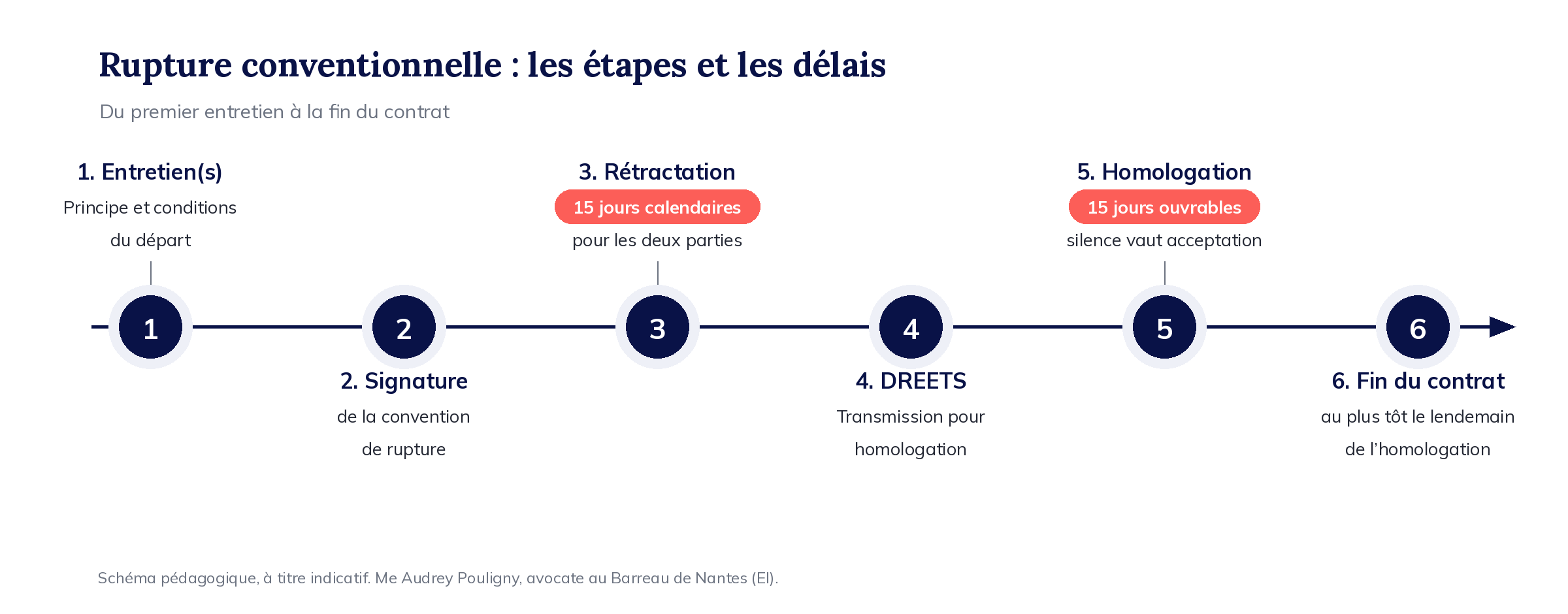
The process follows a few specific steps. One or more meetings are held to discuss the terms and conditions of your departure. During these meetings, you may have someone assist you, such as a staff member.
The 15-day cancellation period
Next comes the signing of the agreement. Starting the day after the agreement is signed, a 15-day cooling-off period begins for both you and the employer. During this period, either party may change their mind without having to provide a reason. This is a chance to take a step back: if you still have any doubts, you can use this time.
Approval by the DREETS and the end of the contract
Once this period has elapsed, the agreement is submitted to the DREETS for approval. The agency has fifteen business days to respond, and failure to do so constitutes approval. The agreement specifies an end date for the contract, but this date cannot be earlier than the day following the date of approval.
What pitfalls should you avoid before signing the agreement?
Analysis of the proposed amount and consent
First, check whether the amount offered is in line with your length of service and your actual circumstances. A severance package that meets only the legal minimum may not necessarily reflect what your case warrants.
You should also consider the circumstances. A mutual termination agreement requires the free consent of both parties. If it is imposed on you, presented as the only option, or if it occurs under pressure, the consent may be invalid, which could open the door to a legal challenge.
The Case of Disguised Dismissal and the Final Settlement
Similarly, when a mutual termination agreement actually masks a disguised dismissal, harassment, or employer misconduct, other legal remedies may offer greater protection. Each situation must be examined on its own merits.
Finally, don’t forget the final settlement: compensation for unused paid time off and any bonuses you may be owed. A mutual termination agreement does not deprive you of any of these rights.
Mutually Agreed Termination and Settlement: A Technical Interplay
The Impact of Settlement Payments on the France Travail Deferral
To get more, some employees agree to have the supplement take the form of a settlement, that is, an agreement that settles a dispute through mutual concessions. The idea may be sound, but it is more complex than it appears, and its integration with the mutual termination agreement requires caution.
The main point to watch out for is the specific waiting period for benefits. Amounts related to the termination that do not stem directly from the law or a court decision are included in the calculation of this deferral, which pushes back the start date of your France Travail benefits by the same amount. A settlement payment may therefore, depending on the circumstances, extend the duration of the deferral (Unédic Circular No. 2025-03 of April 1, 2025).
The wording of the protocol alone is not sufficient to determine this classification. France Travail and URSSAF focus on the actual nature of the payments, not on how they are presented. There is no one-size-fits-all approach: each case is considered individually.
In practice, if an agreement is poorly drafted or comes at the wrong time, the employee may end up using their negotiated severance pay to cover their period of unemployment: the payment of the negotiated amount then triggers a deferral of France Travail benefits, meaning a temporary suspension of unemployment benefits. Hence the importance of seeking legal counsel to properly structure the negotiation and drafting of the agreement.
Tax treatment of the amounts paid
The social security system follows the same logic. A settlement payment that is genuinely intended to compensate for non-wage-related harm—whether personal or professional—may be excluded from social security contributions (Civil Cassation, 2nd Chamber, January 30, 2025, No. 22-18.333). However, simply drafting the settlement agreement is not enough: the actual existence of the harm must be established. This is why a settlement must be carefully constructed, and the draft should be reviewed before signing.
Key Takeaways
- At the individual level, this is the only way to terminate a permanent employment contract by mutual agreement, and it entitles you to unemployment benefits if you meet the usual requirements.
- The severance pay cannot be less than the statutory amount (or the amount specified in a collective agreement, if that is more favorable), but it is negotiable above that amount.
- After signing, you have fifteen days to cancel; the contract’s end date cannot be earlier than the day after approval.
- Adding a transaction is a technical matter: it is the actual nature of the amounts, not their description, that determines your contributions and benefits. This must be examined on a case-by-case basis.
- There’s no need to rush your response: check the amount and the context before signing.
This article is intended solely for educational purposes. Every situation is unique and requires a case-by-case assessment.